Apple's New iPod Line: the Shuffle, Nano, and Touch
Apple today announced a refresh of its iPod line, with new models of the iPod Shuffle, iPod Nano, and iPod Touch.
The iPod Touch adds the iPhone’s 960×640 IPS “Retina” display, A4 processor, and gyroscope. It also adds front- and rear-facing video cameras, designed for use with Apple’s “FaceTime” video chat software. Prices are $229 for the 8GB model, $299 for 32GB, and $399 for 64GB.
The iPod Nano has the most drastic change: its size was cut roughly in half so only the screen remains (no more click wheel). The screen is now a touchscreen and has a home screen with specialized “apps” (like audio and photo players), but it won’t run normal iPhone apps and games. It gains FM radio capability and Nike+ pedometer support, but it loses its camera and the ability to display video. The prices are $149 for the 8GB version and $179 for the 16GB. It now has a clip like its smaller Shuffle sibling.
Finally, the iPod Shuffle actually gets its clickwheel back, but otherwise remains largely unchanged from the last version. It holds 2GB and costs $49.
Of note, the iPod Classic hums along unchanged, at $249 for a model with a 160GB hard drive.

The New Sony E-Reader 350
Today, Sony refreshed its line of e-readers, bringing the new e-Ink Pearl screen (used in the Kindle 3) to the Sony line. One could argue that Sony started the modern e-reader revolution (as its first model came out before the Kindle), but it wasn’t until Amazon’s Kindle 2 came out in 2009 that e-reader sales really took off. Since then, Sony has been the forgotten one of the “Big 3″ (Amazon, B&N, Sony) — and has even taken a back seat to Apple (which doesn’t even make e-readers) in the eyes of many.
Like with much of their other technology, the Sony hardware is impressive, but somewhat quirky, expensive, and lacking in ease of use.
First, the good news: the new Sony e-readers have the higher-contrast e-Ink Pearl screen we’ve discussed when covering the Kindle 3. They are also very small and light — even smaller and lighter than the K3. They all sport new touchscreens that are layered behind the e-Ink screen and supposedly don’t impede reading (the old touchscreens made the screen harder to read and thus kinda sucked). And they support DRMed ePub files, so you can read library books on them (although it’s a bit of a hassle).
On the down side, they’re considerably more expensive than the Kindles, their entry-level version only has a 5″ e-Ink screen (compared to the 6″ one found on Kindles and Nooks), and only their most expensive model (not yet available) has wireless connectivity — the 2 models available now don’t even have Wi-Fi, let alone 3G. That means you have to use your computer to purchase, download, and transfer books to your device.
There are three models: the 5″ Sony PRS-350 (“Pocket Edition”) for $179, the 6″ PRS-650 (“Touch Edition”) for $229, and the 7″ PRS-950 (“Daily Edition”), due out before the holidays for $299.
All 3 models use the new e-Ink Pearl displays and improved touchscreens. The Touch Edition adds the larger (standard-size) screen and memory slots. The Daily edition adds an even larger screen and Wi-Fi + 3G wireless connectivity.
The 5″ PRS-350 Pocket Edition has 2GB of built-in storage (no memory card slots), weighs only 5.64 oz (the Kindle 3 Wi-Fi weighs 8.5), measures just 5.71 x 4.11 x 0.33 inches, and costs $179. Compared to the Kindle 3 Wi-Fi, you pay $40 more to get a touchscreen, ePub support, and smaller size, but you lose out with a smaller screen, no wireless connection, no Internet, no text-to-speech, worse battery life, less storage, and you don’t get to use Amazon’s Kindle e-book store: Sony’s E-Reader Store is far inferior. For just $10 more, you could even splurge for the Kindle 3 Wi-Fi + 3G, and get unlimited 3G connectivity for life.
The 6″ PRS-650 Touch Edition (does that name make sense when they all have touchscreens now?) costs $229, and brings you the larger screen and expandable memory in a slightly larger but still light (at 7.93 oz) package. For $90 more than the K3, you get the same size (and type) screen, so it’s more of an apples-to-apples comparison. Unfortunately, the library book support (an important feature), touchscreen (which I don’t think adds much to the reading experience), and slightly lighter weight don’t outweigh the $90 cost savings and other advantages of the Kindle.
The 7″ PRS-950 Daily Edition adds wireless (Wi-Fi and 3G) connectivity, along with a larger 7″ screen. At 8.99 ounces, it’s fractionally heavier than the K3, but still light enough for easy one-handed reading; that’s probably a good trade-off to get a larger screen (which means more words per page and fewer page turns when reading, especially if you like to read at larger font sizes). The problem is the $299 price tag, which pushes it almost into the 9.7″ Kindle DX2 territory ($379).
Sony is known for making great hardware, but they tend to drop the ball on customer experience (why are they still forcing us into Memory Sticks instead of letting us use the SD and MicroSD cards we have lying around?). Here, Sony doesn’t offer a way to buy and download e-books wirelessly, whereas the Kindle lets you buy any book you can think of in 30 seconds, without a computer. Even when using your computer, you’ll find the Sony E-Reader store almost an afterthought, with lower selection, worse prices, and an inferior browsing experience to the Kindle store. I’d only recommend the Sonys to someone a bit computer-savvy and who enjoys the hassle of finding e-books from other sources (like Project Gutenberg and libraries).
And, as with most Sony products, the bottom line is that they’re too expensive compared to the competition. I just can’t see paying close to double the price (compared to the $139 K3 Wi-Fi) for the $229 Touch Edition, and not even getting Wi-Fi connectivity.
But, if you really like touchscreens or library books, and are OK with using your computer to find, organize, and download e-books, the new Sony E-Readers are nice devices with great screens. They also offer options, if you prefer a slightly smaller or larger screen. Just don’t look too closely at the prices. =)
Staples announced today that they will be carrying the new Kindle 3 e-readers in their retail stores “this fall.” They will carry the $139 Kindle 3 Wi-Fi, the $189 Kindle 3 Wi-Fi + 3G, and “in late fall,” the larger $379 Kindle DX 2. This should offer more people the opportunity to see in person how easy on the eyes and paper-like e-Ink displays really are. Until then, you can still see the older Kindle 2 models at Target, or see the Nook at Barnes & Noble or Best Buy.
In other news, on the heels of the introduction of the lower-price Kindle 3 Wi-Fi for just $139, Kobo has wisely discounted its own Kobo E-Reader (which trails the Kindle and Nook in speed and features) to $129 to compete. While I like the Kobo’s light weight and focus on reading, I still think the new K3 is a better value. But the lower price is a step in the right direction — you can go check out a Kobo at a Borders store near you.
Please excuse me for poking a bit of fun at all the “iPad [or whatever magical device] is a Kindle Killer” article headlines, but it seems to me that the only real device with a chance of “killing” reading is the television. I just saw this report by Bowker, which proudly announced that “More than 40% of Americans over the age of 13 purchased a book in 2009.”
Now, not to delve too deeply into the math, but if 40% of Americans bought a book in 2009, then that means almost 60% of adults didn’t buy even one single book all last year. That’s a pretty depressing number to me. I mean, I know reading isn’t “cool” anymore, but I would have thought more than half of Americans would buy a book in a whole year.
It’s especially depressing when you compare it to TV statistics: 99% of American households own a TV, and on average, watch it between 4-6 hours a day. Hours a day vs. not even one book in a year. I couldn’t even find statistics for the percentage of people who watched at least one show on TV last year, presumably because everyone knows it’s 100%.
The sad thing is, most of the crap on TV is just, well … crap. Anything even remotely good (*sniff* Firefly *sniff*) gets cancelled anyway. If it wasn’t for Gator football games, I’d have pretty much no use for TV. As it is, I don’t own one (my wife has a small one hooked up to rabbit ears — no cable), although we do watch a few shows on Hulu.
Anyway, I need to head back to some reading / e-book forums to restore my faith in humanity, by hearing more stories of people who read 10 books a week and have a “to be read” list of 500 titles on their Kindles. Until then, feel free to leave a comment below telling me how often you read instead of watching TV.
Yes, I guess I can wait until the next commercial. *sigh*
Just to follow up on a couple of posts from earlier this month:
Barnes & Noble has around 20% of e-book market share.
As I estimated in my post on market share on August 2, Amazon probably has about 75% of the e-book market, and B&N has most of the rest: I pegged the figure around 18-20%. Today, B&N confirmed (without giving exact specifics, of course!) that their e-book market share is now “higher” than their print market share, which is 17%. Sounds like 18-20% to me!
Explaining the slight dip in Q2 e-book sales.
Last week, I took a look at June’s e-book sales figures and the Q2 2010 numbers, which were slightly below Q1 2010. (While they were still double last year’s numbers, any dip is unusual, as e-book sales have been consistently increasing at a rapid pace.) I looked at a few possible explanations for the dip, including:
- Lots of people receiving e-readers for Xmas 2009 and buying lots of e-books for their new toys in January 2010.
- Publishers insisted on agency model (read: higher) pricing starting in Q2, and raising new release e-book prices from $9.99 to $12.99 and $14.99 shockingly decreased revenue (who could have ever seen that coming?).
- The industry e-book sales figures don’t include sales from independent authors (like yours truly), who are probably earning a larger slice of the pie.
Well, today I see a pair of articles analyzing the dip in Q2 e-book sales and attributing it to: post-Xmas buying and agency model pricing, and that indie author retailers like Smashwords weren’t being included in the data.
Sorry for the “I told you so” post, but it was nice to see affirmation from several different sources of e-book trends I’ve been predicting on this blog for months.

The New Kindle 3 (in charcoal gray): Lighter, Smaller, Faster, and Less Expensive Than The Kindle 2 (white)
Amazon’s new Kindle 3 debuts in a few days, and reviews are starting to roll in. Below are links to some early reviews. The consensus? Most reviewers agree it’s the best e-reading device out there. The average ranking is 8 or 9 points out of 10 (or 4 to 4.5 out of 5). Most agree that it combines a number of evolutionary improvements (as opposed to one or two huge new features) to make it much more refined, and a significant improvement over its predecessor, the Kindle 2 (which was already the most popular and best e-book reader available). Many of the reviewers also expressed the opinion that the Kindle 3 was “ready for prime time” or “the first e-reader they’d recommend to the general public” — not just the most avid readers (who probably already have an e-reader and are yearning to trade up).
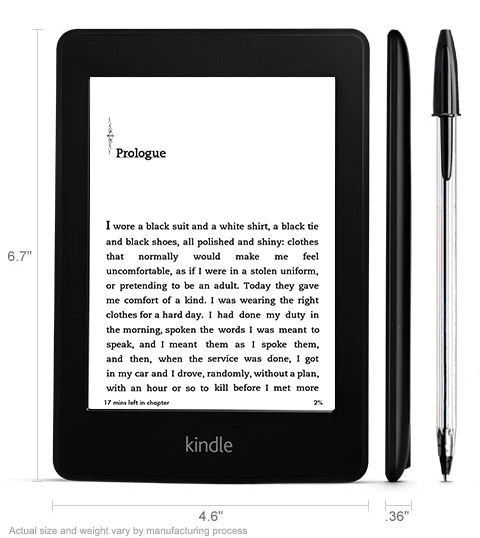
The basics: the new Kindle is less expensive, smaller & lighter, faster, has increased contrast on its 6″ e-Ink screen, has longer battery life, more memory, more font choices, better PDF support, and several other improvements. It weighs only 8.5 ounces (Wi-Fi model) or 8.7 ounces (3G + Wi-Fi model). It has 4 MB of internal storage, good for 3,500 books. And the battery lasts a month. Both models come with free 2-day shipping from Amazon and a no-questions-asked 30-day return policy (they’re pretty confident you’ll like it). Your two options are:
One other quote that jumped out at me:
These days, when anyone who enjoys reading tells me he doesn’t want a Kindle, my answer is simple: “That’s only because you haven’t tried one.”
Enjoy the links to the reviews below!
- Kindle Nation Daily says “This Kindle 3 is a Triple Wow. Five Stars. Two Thumbs Up.”
- Len Edgerly has a 12-minute YouTube video explaining “What’s So Great About The Kindle 3.”
- PC World’s Melissa Perenson says the K3 “feels ready to meet the mainstream masses.” (4.5 / 5)
- PC Mag’s Dan Costa calls the K3 an “Editor’s Choice” and “the best dedicated ebook reader you can buy.” (4 / 5)
- CNET says the K3’s lower price makes it “a solid value for readers looking to make the jump to e-books.” (4 / 5)
- Wired calls it “something readers will want to carry around with them, even in the emerging age of tablet computers.” (9 / 10)
- Telegraph UK calls it an “excellent device” that “is the first ebook reader that has a credible chance of cracking the mass market.”

Does DRM Prevent Piracy Or Cripple Legitimate Users?
DRM, which stands for Digital Rights Management, is a form of copy protection sometimes embedded into electronic media (like e-books, MP3 music files, etc.). Its purpose is generally noble: prevent piracy (unauthorized copying and distribution of copyrighted material) so that the content creators (authors, musicians, publishers) can earn the money they deserve for their work.
NOTE: If your stance is that copyright is evil and “all information wants to be free” and that people shouldn’t get paid for creating music or writing a book or researching a newspaper article (but should get paid for fixing your car or writing bad advertisements or whatever you do for a living), then I don’t think we’ll see eye to eye and you may as well move on to another blog.
But here’s the problem with DRM: it generally doesn’t prevent piracy, since almost all forms of DRM have been hacked, and it just ends up annoying legitimate, paying customers. So the pirates strip out the DRM and continue sharing files illegally, and the actual customer (who we as content creators should be bending over backwards for) is annoyed, limited in how they can use the music or e-book they purchased, and sometimes has to buy it again just because they got a new computer or e-book reader. Lame.
Let me give you a simple example to explain why DRM is broken: I have a few MP3 songs on my computer. Most of them came from old CDs that I had bought. I bought a few from Apple through iTunes several years ago. They’re all mixed together, and I don’t really remember which songs came from which source — except that I was forcefully reminded of it when I tried to do something as simple as transfer the songs to my wife’s iPod.
Now, let’s make this clear: I own the music. I own the Mac. I own the iPod (OK, I’m borrowing my wife’s iPod for a trip). I listen to the music on the Mac, and now want to listen to it on the iPod. No piracy is going on.
I go to copy over all my music onto the iPod and get an error — iTunes tells me that certain songs (the ones I had purchased through iTunes) are copy-protected and can not be used on my wife’s iPod. Now think about this for a second. Had I pirated (stolen) the songs, I could copy them over no problem. But since I paid for them, I can’t do something as simple as listen to songs on an iPod? What? (NOTE: there might have been a way to authorize the iPod or blah blah, but at that point I was just frustrated and didn’t want to troubleshoot and figure out something that shouldn’t be that difficult.)
Now, when I offer a product (like my e-books over there in the right-hand column) for sale, I want to provide a quality product at a fair price. I want my customers to get a pristine file, the best one available. I ensure that it looks good, has no formatting problems, no typos, and it’s the newest and best version. If someone is paying me money, I want them to have a pleasant, easy experience. I want them to get value for their money — so even if there were a pirated version of my e-books floating around out there, I want the customer who buys from me to get a superior product. I want their $2.99 to buy them peace of mind (knowing they’re doing the right thing and supporting the author), a pristinely-formatted file, “tech support” if they have issues with it, and the ability to legitimately use that file and enjoy it — even if they trade in their Nook for a new Kindle 3.
And that’s why I don’t put DRM on my files (NOTE: e-books you buy directly from my website have no DRM, and neither do my e-books at Amazon or Smashwords. B&N, Apple, Kobo, and Sony currently put DRM on files and there’s no way for me to opt out of it, like I did with Amazon.) If a customer asks, I’m also happy to send them my e-books in any other format they’d like. It’s not that I support piracy — in fact, I think many “anti-DRM” arguments are actually “I want stuff for free” rationalizations. And I’m not supporting taking DRM off files that have it — that’s against the law. But I personally generally avoid buying files that have DRM attached — there are plenty of DRM-free e-books out there that I choose to buy instead.
So, back to my song problem. I have the iPod connected, and my choice is now: (a) buy another copy of these songs through my wife’s account or figure out how to “authorize” her iPod, (b) not have the songs I paid for on the iPod, (c) find a way to download something to strip the DRM off the files (against the law), or (d) download pirated copies of the songs I paid for and not have to deal with DRM at all (also illegal, but by far the easiest and quickest solution). This is why, in my opinion, DRM is broken: it doesn’t actually stop piracy, it just annoys legitimate customers — even to the point of pushing them toward piracy! Maybe someday they’ll invent some better, less invasive form of DRM, but the way it is today just sucks.
So, what would you do? And why should DRM force purchasers to make that choice?

June 2010 E-Book Sales Rise Slightly
I’ve been tracking e-book sales statistics here for a while, following the rise of e-books from less than 1% of the market, to about 1% in 2008, 3% in 2009, and over 8% so far this year. The latest figures are in for June 2010 (and the second quarter of 2010), and they represent a slight increase from the past couple of months. Retail e-book sales clocked in at $29.8 million dollars for June 2010, and $88.7 million for Q2, 2010 (April, May, and June). The June sales are an increase of 118.9% over last June’s numbers, and sales year-to-date are 204.2% higher than the first two quarters of 2009.
I should point out that the monthly and quarterly figures don’t seem to correlate exactly — it seems the IDPF (which releases quarterly figures) adds something to the monthly figures that come from the Association of American Publishers. Please keep in mind that e-book sales figures are only an estimate, and an incomplete one at that. They don’t get their data from e-book retailers (like Amazon, B&N, and Apple), which are notoriously secretive about their e-book sales, they get it from publishers. But they only include figures from certain large publishers, and ignore sales of e-books through smaller channels, such as small presses and independent publishers. For example, I’m just an unknown indie author, but I’ve sold over 6,000 e-book copies in the first 6 months of this year, and they aren’t counted in the numbers above. So it’s safe to say these numbers are inexact and underrepresented.
Those caveats aside, the monthly sales totals so far this year are:
- Jan 2010: $31.9 M
- Feb 2010: $28.9 M
- Mar 2010: $28.5 M
- Apr 2010: $27.4 M
- May 2010: $29.3 M
- June 2010: $29.8 M
And the quarterly figures given by the IDPF, with the totals of the monthly numbers above in parenthesis for comparison:
- Q1, 2010: $91.0 M ($89.3 M)
- Q2, 2010: $88.7 M ($86.5 M)
On a positive note, June sales continued to increase over May, which itself increased over the low point in April. On the down side, the strong May and June sales weren’t enough to overtake the Q1 numbers, which were mostly buoyed by huge numbers in January. There are a few possible explanations and observations I draw from this data:
- Millions of e-readers were sold over the holiday season at the end of 2009, and all those new Kindle and Nook owners needed something to read, and may have bought a lot of e-books in January.
- The combination of new e-reader owners stocking up on e-books and terrible winter weather may have accounted for very strong e-book sales in the early part of the year, which cooled off as the weather warmed up and more people ventured outside (doing non-reading activities or visiting physical bookstores).
- Publishers’ insistence upon the agency model (where they forced retailers to raise e-book prices) at the start of April seems to have caused a dip in e-book sales, which are now recovering and possibly continuing their upward trend.
- The introduction of the iPad (in April) didn’t seem to help e-book sales much, and may instead have hurt them, as some people debating between a dedicated e-book reader and a multi-function device chose the iPad, and then ended up playing more games, watching movies, and spending time on Facebook instead of buying and reading e-books.
- The trend in May and June is positive, and sales in those two months are higher than any other month except January, which may have been a post-holiday / winter weather spike.
- On the other hand, Q2 sales are down (or at best roughly flat) from Q1, and e-book sales certainly don’t seem to be increasing at the blistering pace they showed for the past several years (where they doubled or tripled each year). Is it just a temporary dip (due to the agency model and the iPad), or the sign of a leveling off of e-book market share?
To expand a bit on the last point, e-book sales have been increasing so rapidly, that the first 6 months of 2010 have already exceeded all of 2009 ($175.8M vs. $165.8M). And 2009’s sales are over triple 2008’s ($165.8M vs. $53.5M). This is the first quarter where sales have declined in the past three years, but they have bounced around a bit and then continued their upward momentum before, so I think it’s too soon to say that e-book sales have plateaued. Looking at the chart below, it looks more like Q1 2010 was abnormally high than that Q2 2010 was abnormally low. Most estimates still have e-books steadily increasing their market share, and most industry insiders expect e-books to account for 25% of book sales within the next 2-4 years.

Q2 2010 E-Book Sales Cool Slightly From Q1 Pace
I think it’s encouraging to see June’s sales continue the upward trend from May, and hopefully April will just prove to be a one-time dip, caused by agency model pricing. One stat I’d love to get my hands on: what percentage of e-book sales are independent authors responsible for, and how quickly is that number increasing? Maybe the book sales of traditional publishers are flat, but that doesn’t mean overall e-book sales are flat as well.
UPDATE: A few industry analysts confirm my explanations for the dip in Q2 sales.
Inspired by a reader who found the Right Ascension Theme and enjoyed listening to it on her Nook as she read the e-book, I thought I’d highlight the musical score that my good friend John Main created to accompany the novel. (You can find a synthesizer version and a guitar version at the link above.) John delivered a haunting score that mirrored the plot arc of Right Ascension: from the mystery surrounding the discovery of a new alien species, to the suspense and buildup as the story progressed, and the climactic showdown at the end.
Please feel free to listen using the player below or download it to listen on your computer or mp3 player — or even on your Kindle or Nook while you read the e-book version of Right Ascension. And please be sure to leave any comments you might have below — I’ll be sure to forward them on to John.
Original musical score composed by John F. Main ©

Amazon's Kindle 2 and Barnes & Noble's Nook
I thought I would present this E-Reader Buying Guide for people who may not know much about the different e-book readers out there (like the Kindle and Nook). I’ll try to explain the benefits and drawbacks of e-readers in general, and help you figure out if you’d benefit from owning one or not. Then, I’ll also look at which one might be right for you.
To decide if an e-reader might be right for you, let’s first ask a few questions:
Do you enjoy reading?
The first thing to figure out is whether or not you even like reading. Do you enjoy curling up with a good novel? Do you fondly remember books you’ve read? Do you get sad when you come to the end of a good book, and re-read the last page a couple of times, because you don’t want it to end? (Yeah, I do that.)
If so, odds are that you will enjoy an e-reader — we’ll find out in more detail below. If, however, you just don’t enjoy reading books and never did, then an e-reader isn’t the device for you. It won’t magically make you like reading if you hated it before. You may prefer an iPad (where you can play games and surf the web and watch movies), but it doesn’t make sense to buy a device designed for reading if you don’t enjoy reading at all.
How often do you read?
Are you an avid reader, reading a book (or several books!) a week? Are you an average reader, reading a book or two a month? Or just an occasional reader — maybe you read a couple of hot books a year or read a bit when you’re on a flight or on vacation?
For avid readers, I almost can’t see NOT having an e-book reader. There are many benefits. First, you’ll probably save enough money on less expensive (and free) e-books to pay for the device several times over; e-books typically cost less than printed books, and millions of classic books (anything published before 1923) are free. Second, you’ll probably enjoy the reading experience more, as e-readers offer adjustable text sizes, the ability to search and bookmark and write notes, a built-in dictionary, text-to-speech, and ultimate portability. Third, truly avid readers often have issues with storage space, and run out of bookshelves (and closets, and storage units) to keep all their old books. Imagine carrying thousands of books with you anywhere you go (including on a trip), yet it takes up the space of a single paperback. And you can find any book (or even a favorite passage hidden somewhere in your library) with a quick text search. Nice.
For the average reader, e-book readers are compelling for many of the same reasons listed above. Depending on how many e-books you buy and what types of printed books you used to buy ($25 hardcovers, used books, or the library?), you may or may not save a lot of money by going electronic. On average, e-books cost less: new releases are $10–$13 (instead of $20+ for hardcovers), older titles are $5–$8 (instead of $7–$12 for paperbacks), there are lots of low-cost options (like $0.99 to $2.99 emerging authors), and millions of free classics like Shakespeare, Pride and Prejudice, Sherlock Holmes, etc. And it’s still convenient to throw your entire library into your purse on a trip, to adjust text sizes so every book is easy to read, to have any word definition at your fingertips, and to wirelessly download books in 30 seconds instead of making a trip to a book store or waiting for shipping. For these reasons, people who enjoy reading but don’t read as much as they’d like to, often find that they read more on an e-reader since it’s more convenient and less expensive to buy books, and it’s easier to bring their entire library with them and sneak in more reading time on the subway or at a doctor’s office.
For the occasional readers, it’s a tougher call. You probably won’t save enough money on e-books to pay for the cost of the device, unless you read mostly free classics or very low-cost e-books. You’ll still get the portability and readability benefits I mentioned above, and you can use your e-book reader to do some light Internet browsing, book shopping, or Wikipedia lookups. But if you prefer watching movies or surfing the Internet to reading books, you may prefer a device like the iPad, which is more multifunctional (but more expensive and worse at actually reading books), as that will give you the option to buy an e-book or two through the iBook Store or Kindle for iPad app if you ever get the urge.
Are you attached to paper?
I hear this a lot, even from the biggest reading fanatics, people who I KNOW would really enjoy an e-book reader if they got one. People talk about the “smell” and “feel” of books — which I quickly realized was nonsense when I got my Kindle 2. Look, I’ve always loved reading, but it’s the words on the page that move me, not the smell of paper and ink and glue. I don’t bury my nose in a book — I immerse my mind in the words. And the words are still there — better than ever, since they’re whatever size I want them — on an e-book reader. I literally have not heard of a single person who tried an e-book reader and didn’t like it because they missed the “smell” or “feel” of paper.
But if you’re still not sure, Amazon is very generous: order a Kindle and try it free for 30 days. If you don’t like it, send it back and get a full refund — including shipping — no questions asked. What do you have to lose?
What will happen to my e-books? Will they become obsolete?
Since e-books are digital, like MP3 music files, they can theoretically remain perfect forever — the pages will never turn yellow or fall out. You can back up your e-book files on a DVD or hard drive (just like you might back up other computer files) and retain them forever. And Amazon and B&N store your purchases online for you as well — even if you lose or break your e-reader, you just download them again. You can also read your e-books on PCs, Macs, and smartphones, and none of those are going away anytime soon.
Some e-books (like the free classics, and many inexpensive e-books by independent authors — like mine) do not have copy protection, or “DRM” attached to them. This means you can always convert them from one e-book format to another, and can easily read them on any device made now or in the future. E-books are digital, so they’re not like a VHS tape or LP record that gets replaced by a new physical format (DVDs or CDs). If a new e-book format emerges, there will also be software to convert your books into the new format for you.
On the other hand, most best-selling books by large publishers do have DRM attached, and you can only read them on the family of devices you bought them for: so e-books bought from Amazon will work on any Kindle (or Kindle 2, 3, or 10), and B&N e-books will work on the Nook. I recommend Amazon and B&N partially because I have confidence those two companies will be around and selling e-books and e-book readers for a very long time.
Can you afford an e-reader?
But how practical is it? I’ve talked above about how an e-book reader could pay for itself, or even save money in the long run for avid book readers. Even if that’s the case for you, there’s the initial outlay of $139–$199 to contend with. I don’t have access to your bank account, so I can’t answer the question for you. All I can say is that I am a pretty frugal guy (I don’t even have a TV, let alone cable), and I think the Kindle is a phenomenal value at $139.
Which e-reader is right for me?
This could be a whole separate article (or 3), so I’ll be brief. The bottom line is that my only recommendations for serious readers would be Amazon’s Kindle or Barnes & Noble’s Nook. Both are more similar than different, and both make excellent e-readers. Both are roughly the same price and size, and have similar e-Ink screens (see this post for the difference between e-Ink and LCD screens). But Amazon just came out with the new Kindle 3 (which I review in more detail here), which has a better screen, and is smaller, lighter, and a little cheaper than the Nook. (B&N will probably release a Nook 2 before Xmas, and I’ll revisit the question then.) The Nook does have certain advantages: a small color LCD screen in addition to the main e-Ink screen, support for free library e-books through Overdrive, an SD memory card slot, and a user-replaceable battery. On the other hand, the Kindle 3 is faster, has text-to-speech, has generally better software, and the battery lasts longer. Another factor is whether you prefer shopping at Amazon or Barnes & Noble.
Both the Kindle and Nook come in two versions: Wi-Fi only, and Wi-Fi + 3G. The Wi-Fi only versions can connect to wireless networks the same way your laptop can: you may have Wi-Fi access at home (if you have a wireless router), at work, at Starbucks, McDonalds, or some hotels and airports. The Wi-Fi + 3G models can connect through Wi-Fi or through the AT&T 3G cell phone network — so they can connect pretty much anywhere your phone gets signal, and they include free lifetime 3G service. Keep in mind you don’t need any sort of connection — you can read books without it, and you can buy books on your computer and transfer them to your e-reader with the included USB cable. But wireless access allows you to shop, buy, and download books on-the-go, connect to the Internet, and sync your place in the book across your e-reader and Kindle for iPhone or B&N eReader apps. The Kindle 3 Wi-Fi costs $139 and the Kindle 3 Wi-Fi + 3G costs $189 (with free 2-day shipping). The Nook Wi-Fi costs $149 and the Nook Wi-Fi + 3G costs $199 with free shipping.
At the end of the day, my bottom-line recommendation is for most people who enjoy reading to purchase the Kindle 3 Wi-Fi for $139. At that price, you’re getting the newest and best e-reader on the market, the device with the best screen, longest battery life, best software, lightest weight, and best e-book store. If you prefer the flexibility of free 3G coverage and can afford another $50, the Kindle 3 Wi-Fi + 3G for $189 is also an excellent value. Finally, if you prefer B&N, or if one of the Nook’s advantages (like library e-books) is a “must-have” feature for you, then I’d recommend one of the two Nook models. People who like to read won’t go wrong with any of those 4 choices.


Recent Comments