Cheaper Than Dirt

 Posted by at 10:30 PM  Tagged with: ,
Mar 042011
 

As gas rises well above $3 a gallon, and a latte at Starbucks can run you close to $4, it got me thinking more about the prices of e-books. There is lots of debate over bestsellers selling for over $9.99 — in many cases $12.99 or $14.99, which is beyond the price range I will generally pay for e-books. But, on the other end of the spectrum, one of the perennially most popular posts at the authors’ forums I hang out at is some variation of “Should I price my e-books at $0.99 or $2.99?”

This choice always manages to depress me. I understand the appeal of pricing our work as low as possible ($0.99 is the minimum sale price on Amazon’s Kindle store) and getting as many readers as possible. At one point, I even sold my novels for $0.99 each. But I also understand it’s an unsustainable price point, one that will not support authors producing quality work. Making the choice even less appealing is the fact that novels priced between $2.99 and $9.99 now earn 70% on Amazon, but only 35% for books below that price. (Barnes & Noble’s breakdown is similar: 65% / 40%). So, you’re only making half the royalty on one-third the price — meaning you make one-sixth the royalty on $0.99 books as on $2.99 books, leaving only 35 cents per sale. You’d have to sell 100,000 copies a year just to make any kind of living (yes, royalties are taxed, including self-employment tax), and there just aren’t many authors who will manage that. (UPDATE: there are 44 indies on the planet selling that many through Amazon.)

And, really, can readers not afford $2.99 for an e-book? Isn’t that a more than reasonable price? How many readers will say, “Sure, I’ll buy it for 99 cents, but $2.99 is just out of my price range”?

This debate also got me thinking about what a great deal a full-length novel for just $2.99 really is. For that price, you get several hours of entertainment (compared to a 90-minute movie for $10 or more), an instant download, a digital copy that lasts forever, text-to-speech, and all the other cool features of e-books, like adjustable text sizes and built-in dictionaries. At $2.99, that’s cheaper than dirt. I mean, what else can you buy these days for under $3? I set out to take a look.

Dirt: twice the price of e-books

Well, you can’t buy a gallon of gas or a latte for under $3 these days, but how does $2.99 compare to the prices of a few other inexpensive items? I mean, is an e-book literally cheaper than dirt?

I checked Amazon.com, and I couldn’t find a bag of dirt for less than $2.99. Their most popular brand of dirt is $6.99 — you can buy both books in my Edge of Apocalypse Series (Right Ascension and Declination) for less than that!

This is a depressing start.

OK, this is just insulting.

OK, let’s try something lower than dirt. How about … I don’t know … how about poop? Surely an e-book will be worth more than a bag of poop! Let’s check it out on Amazon … oh, crap. Does that bat guano really cost almost 10 bucks?? That’s more than all 3 of my novels combined!

All right, I know what you’re saying now: dirt and fertilizer can actually be useful, for gardening. Fine. A depressing line of thought, but fine. So how about if we look at something totally useless, and also gross and worthless. Something like … lemme see … fake poop! Yeah! Surely my e-books are worth more than fake poop, right? Right? Wrong.

So I set out to find the most useless item I could find, something with no redeeming value whatsoever. Some product that really just … stunk. And then I found this: a foul-smelling spray called (I swear I am not making this up) “liquid ass.” Surely my e-books are worth more than — wait, that junk is almost $5? And that’s on sale? I’m in the wrong line of work.

Water? For $3.39? That's still Hydrogen and Oxygen, right?

OK, maybe I’m going about this the wrong way. All of those things, while seemingly worthless, might have some value to someone (gardeners or pranksters, I suppose). But what about stuff that is even more plentiful than dirt or bat poop … stuff that’s all around us, like water or air??

So I checked trusty Amazon.com again and found this single bottle of water for … $3.39?? Wait, guys, water is still just Hydrogen and Oxygen, right? And you’re charging over $3 (plus shipping) for one lousy bottle? You know water falls from the sky, for free, right? It’s almost as plentiful as …

Then it hit me: air. Fine, e-books are just electronic ones and zeroes, etherial and without tangible form. But at the very least I should be able to rest assured that no one would pay more than $2.99 for air.

Unfortunately, the briefest of Amazon searches informed me that, yes, people are purchasing air in a can, and they’re paying $20 for the privilege. That’s … that’s more than I charge for a combination package of all 3 of my novels in paperback form.

Since this little experiment was depressing me more than I anticipated, I figured it was time to wrap it up. What is something that literally no one would ever pay more than $2.99 for? Something worth so much less than my e-books, that there’s no way it costs as much. Something that’s only worth a few cents?

The last straw.

That’s it! What would people pay to buy, literally, a few cents? A penny. A one cent piece. You know, the things you throw away or leave on the counter when you get them in change? And not an old, rare penny with numismatic value either, I mean a brand-spanking-new, not-worth-more-than-a-penny penny.

At this point, if I told you 4 new pennies sold for $4.95, would you even be surprised?

Sigh. And some people think e-books should cost less than $2.99?
Mar 042011
 

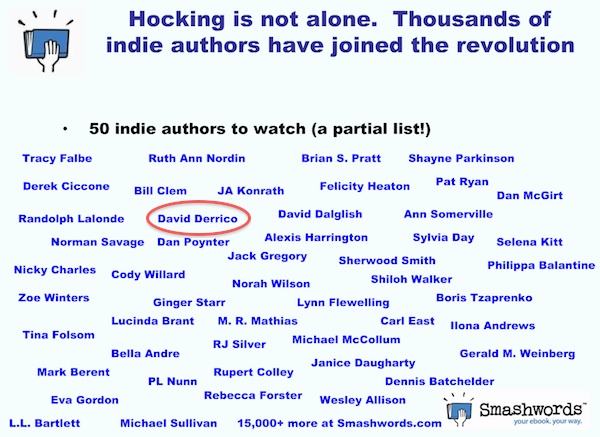
I appreciate being in such great company!

I received a pleasant surprise tonight when catching up on my blog reading: Mark Coker, founder of the e-book distribution service Smashwords (which I use to distribute my e-books to Kobo, Apple, and Sony) mentioned me as one of “50 indie authors to watch” on his latest blog post, which includes a presentation about the upheaval of the publishing industry. As more and more self-published authors like Amanda Hocking and J.A Konrath “break out” (Hocking is closing in on 1 million e-book sales!), and e-books garner a larger and larger share of the book market, we will reach a tipping point where big-name authors wonder why they’re giving publishers the lion’s share of their book proceeds. They’ll compare the 8%–17.5% royalties they get from legacy publishers to the 70% they can earn on their own. They’ll realize they can pay a fixed fee to skilled editors and cover designers and formatters, and retain artistic control, pricing flexibility, and the majority of the proceeds. And they’ll realize they can achieve worldwide distribution through Amazon and services like Smashwords, without their legacy publishers.

The authors on the list above have proven that legacy publishers are missing out on — actually, rejecting is the better word — some very talented authors. Do check out Mark’s blog post and presentation here, and check out Smashwords to find some very good, inexpensive, DRM-free e-books in multiple formats from some of these talented indie authors.

 press  Comments Off on Smashwords’ “50 Indie Authors to Watch”
Mar 032011
 

One result of the agency model

A couple of days ago, Random House became the last of the “Big 6” legacy publishers to switch over to the agency model. The agency model (described in full detail here) forces e-book retailers (like Amazon and B&N) to sell e-books at the prices that the publishers choose, with no discounting allowed. The retailers receive 30% of the purchase price.

Switching to the agency model usually results in higher e-book prices (for example, bestsellers rising from $9.99 to $12.99 or more once Amazon is no longer allowed to discount them), and should ensure that prices are the same at any e-book retailer. (On the plus side, that means there’s usually little point in shopping around for e-books; on the minus side, that means you’ll rarely find a sale or good deal, everything will be “full price.”)

Part of the reason (perhaps the main reason) Random House succumbed, 11 months later, is to get their e-books on Apple’s iBookstore, which requires an agency model contract (the timing of the announcement coming on the heels of the iPad 2 introduction can’t be a coincidence). And some Random House titles are starting to show up in the iBookstore. But, with the iBookstore struggling, was this a smart move for Random House? After all, before the switch, Random House was the only large publisher still using the retail model (the same model used for printed books), where Random House received 50% of the “list price,” which was often the same as the hardcover price, and Amazon could discount the e-book as much as they wanted without cutting into the royalty. So, instead of Amazon selling bestsellers for $9.99 and giving Random House $13 or so, now they’ll sell them for $12.99 and give Random House $9.09 (70%). (Click here for more on the cost breakdowns of e-books and printed books.)

Will iBookstore sales make up for selling fewer books and earning less on each sale through Amazon and B&N? Consider me skeptical. I thought it was more likely that the other large publishers would switch away from the agency model when their original 1-year terms end next month. Do they know what they’re doing, or is this just another example of large publishers hastening their own extinction? Feel free to share your thoughts in the comments below….

 publishing  Comments Off on Big 6 Publishers All On Agency Model

Nook Color $199 at eBay, $50 Off

 Posted by at 9:08 PM  Tagged with: ,
Feb 282011
 

The B&N Nook Color at eBay for $199

If you act fast, you can grab a Nook Color from eBay for $199, which is $50 off the normal price of $249. Use coupon code “CBARNESDD” at checkout through the “Buy It Now” link on eBay. Barnes & Noble is the seller, and it comes with free shipping. You might have to act quickly; the deal is “while supplies last,” and says it expires at 8 AM Pacific time on March 3, although there’s also a countdown timer on the page that shows just under 14 hours remaining.

This is the best deal I’ve seen so far for a new Nook Color.

The Nook Color (discussed more here) is an Android-based “reader’s tablet” with a 7″ LCD screen, and is made by Barnes & Noble and linked to B&N’s e-book store.

 e-readers  Comments Off on Nook Color $199 at eBay, $50 Off
Feb 252011
 

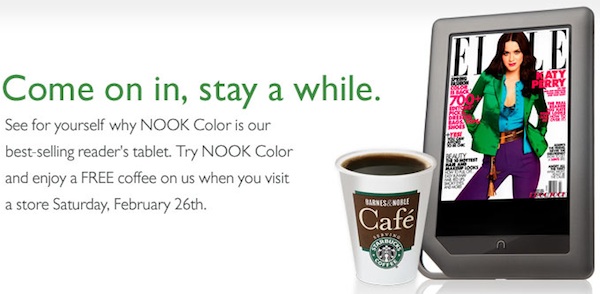
The coffee is free at B&N, the Nook Color is $249

The image pretty much says it all, but head into a Barnes & Noble store tomorrow (Saturday, February 26) and check out B&N’s Nook Color “reader’s tablet,” and get a free cup of coffee at the B&N Cafe. The fine print: you must visit the Nook or Nook Color counter and try a demo unit, then ask for a coffee coupon. The coupon is good on Feb 26 only, only at “B&N Cafe (serving Starbucks coffee)” locations (not Starbucks), and you get one non-customized “tall” (which means “small” in Starbucks language) coffee.

The Nook Color is an Android-based tablet computer with a 7″ LCD screen. B&N markets it as a “reader’s tablet,” and it can read e-books from B&N, as well as color children’s books and magazines. It is $249.

The Nook and Nook 3G are B&N’s e-Ink-based e-readers, with 6″ e-Ink screens, but they’re a generation behind Amazon’s Kindle 3. They are $149 and $199.

It’s a good excuse to stop by B&N this Saturday. If you do, please leave a comment below and let me know what you thought of the Nook Color.

 Uncategorized  Comments Off on Try a Nook Color at B&N, Get Free Coffee
Feb 242011
 

The Amazon Breakthrough Novel Award

Just a quick, excited post to announce that my latest novel, The Twiller, has progressed on to the second round of the Amazon Breakthrough Novel Award Contest. The award comes with a publishing contract with Penguin and a $15,000 advance for the winner.

The field has been whittled down to 1,000 entrants in each category (general adult and young adult), from about 10,000 total entrants. They will be further reduced to 250 in the quarter-finals, announced March 22.

You can learn more about The Twiller and see the description / pitch that got the novel into the second round at Amazon here:

http://www.amazon.com/dp/B003SE7LPW

Grammar Guide

 Posted by at 3:05 AM  Tagged with: , ,
Feb 222011
 

In homage to the hilarious Dave Barry, I thought I would clear up some popular grammar misconceptions by answering grammar questions sent in by readers. Let’s get started!

What is the serial comma, and why should I care?

The serial comma (also known as the Oxford comma, since that’s where it went to college) is the last comma in a list or series such as “red, white, and blue.” Some people don’t use it, mainly because … I don’t know, pressing the comma key a second time in a single sentence is really hard? Sure, most times it’s not really critical, but sometimes it can make a big difference, so it’s best to use it, for clarity. Consider if your wife saw you post one of these two status updates on Facebook:

I had sex with an amazing woman, my wife and my best friend.

vs.

I had sex with an amazing woman, my wife, and my best friend.

The first one is clarifying that the amazing woman is your wife, who is also your best friend. The second one sounds fun but will have you looking for a good divorce lawyer.

What is the deal with people using quotation marks incorrectly?

I’m glad you asked. This is a pet peeve of mine. You see this all the time on signs at restaurants and stuff. When you put something in quotes, you should either be quoting another speaker or using the quotes to mean that something might not really be what it’s claimed to be — like if you say that O.J. Simpson is “innocent” or that Sarah Palin is an “author.” But when a restaurant touts their “Fresh” Fish, I eat elsewhere.

Is proper capitalization really a big deal?

Yes. Proper capitalization is the difference between helping your Uncle Jack off a horse, and helping your uncle jack off a horse.

y r u so srs abt this grammar stuff? its no big deal

Get the hell off my blog.

I always get confused with your and you’re and there, their, and they’re. Help!

First of all, that’s not in the form of a question, but I want to help you out, because there’s no quicker way to look silly than to use one of these words incorrectly. Words that sound the same are called “homophones,” which means that they have negative attitudes toward words of the same sex getting it on. If you don’t know the difference, spell out the words instead of using contractions. Doesn’t “I hate you are stupid blog and you are stupid grammar rules” sound dumb?

Why doesn’t anyone know how to use apostrophes anymore?

Thank you, dear reader, for bringing up this vitally important issue, which I think should be one of our nation’s top 3 priorities, along with curing prostate cancer (or at least finding a better way to check for it) and instituting a college football playoff.

What do all of these examples have in common?

Sale on SUV’s

2-for-1 drink’s

I told my parent’s that school is for loosers

If you answered “they are all abominations,” you get a gold star. Apostrophes are used to indicate a contraction, or possession. Not just because you pluralized something and felt like hitting the apostrophe key since you saved a keystroke by skipping a serial comma earlier.

Well, that’s all for this edition of David’s Grammar Guide. Leave your grammar questions in the comments below, and try not to think too much about how “fresh” that fish you had for lunch really was.

December 2010 E-Book Sales: $49.5M

 Posted by at 5:22 PM  Tagged with: ,
Feb 172011
 

Dec 2010 e-book sales: $49.5M

As I predicted last month, December 2010 e-book sales set another record, at $49.5M for the month, up from a then-record $46.6M in November, and $18.7M in Dec 2009. Year-over-year, Dec 2010 sales are up 164.8% from Dec 2009 numbers.

Here is a rundown of the monthly totals:

  • Jan 2010: $31.9 M
  • Feb 2010: $28.9 M
  • Mar 2010: $28.5 M
  • Apr 2010: $27.4 M
  • May 2010: $29.3 M
  • June 2010: $29.8 M
  • July 2010: $40.8 M
  • Aug 2010: $39.0 M
  • Sep 2010: $39.9 M
  • Oct 2010: $40.7 M
  • Nov 2010: $46.6 M
  • Dec 2010: $49.5 M

Q4, 2010 e-book sales: $136.8M

That puts the Q4 2010 total at a record $136.8M, up from $119.7M in Q3 2010 and $55.9M in Q4 2009. The 2010 year-end total is reported as $441.3M (which differs slightly from the $432.3M I get from summing the monthly totals, but maybe they include some extra sales figures that trickle in for their year-end calculation). Either way, it’s well above the 2009 year-end total of $166.9M, an increase of 164.4%, in fact.

Monthly e-book sales ($49.5M) haven’t quite caught mass market paperback sales ($57.1M) yet, but they’re getting ever closer as e-book sales increase dramatically and print book sales decline from 2009 levels. Mass market paperback sales were $60.2M in October 2010, and $673.5M for 2010 in total, a decrease of 6.3% from 2009 figures ($718.9M). Back in March 2010, I was amazed that e-book sales were 53% of mass-market paperback sales; in December, they were up to 86.7%. Considering how we saw a surge in e-book sales in January 2010 (after millions of people received Kindles in late December for Christmas) and a decline in print book sales (due to snow and poor winter weather), I’m still predicting e-book sales to catch or overtake mass market print sales as soon as January 2011 (which means it would have already happened, we just haven’t gotten the statistics to confirm or deny it yet). UPDATE: January results are in, with e-books easily overtaking MMP sales.

E-books continue to increase dramatically as a percentage of total book sales.

Looking at the overall picture, e-book sales constituted 3.2% of trade book sales in 2009, and that number nearly tripled, up to 8.32% in 2010. This number has more than doubled (and nearly tripled) for 3 years in a row. Of course, that kind of explosive growth can’t last forever, but what percentage of all book sales will e-books constitute in 2011? 15%? 20%? 25%? I wouldn’t bet on a number lower than 12-15%.

 e-books  Comments Off on December 2010 E-Book Sales: $49.5M

Apple vs. Amazon

 Posted by at 7:57 PM  Tagged with: , , , , ,
Feb 162011
 

You didn't really think they could just get along, did you?

It was only a matter of time.

Once Apple entered the e-book business back in April with the launch of the iPad and the iBook Store — and partnered with publishers to cram the agency pricing model down Amazon’s throat — a collision like this was probably inevitable. After all, Apple has been selling e-books to be read on iDevices through the iBook store, while Amazon has been selling e-books for those same iDevices through the Kindle for iPhone/iPad apps. And, it’s pretty clear which of those two e-book retailers has been more successful: Amazon still commands the strong majority of e-book sales, while Apple’s iBook Store has floundered. So, is Apple OK with Amazon moving in and selling all those e-books to iDevice owners?

Apparently not. In the past week, Apple has started “clarifying” its position on e-book stores (and magazine and newspaper publishers) selling content through iOS apps to (what Apple sees as) Apple’s customers. The first salvo was when Apple denied the Sony E-Reader app, claiming that it violated guidelines related to in-app purchases. Over the ensuing week, Apple’s position became more clear, as it is apparently gearing up to require vendors who sell content to do so through in-app purchases. At issue is the current practice of many current apps (like Kindle for iPhone) that take users to Safari to purchase e-books over the Internet, bypassing Apple’s app store and its 30% cut of all app and in-app purchase proceeds. And Apple has given existing apps until June 30 to comply with the new requirement, which is that any app offering out-of-app purchases (like those over the Internet), must also offer an in-app option (at the same price). Of course, the in-app option (which will just be a click, attached to your existing Apple account and payment method) will be much more convenient for most users than launching a website and signing in. (Crazy side-note: Apple licenses Amazon’s patented 1-Click purchasing system.) Even worse, it appears from Apple’s latest statements that apps can’t even link to outside stores (like Amazon), but only offer the in-app purchase!

“Our philosophy is simple — when Apple brings a new subscriber to the app, Apple earns a 30% share,” said CEO Steve Jobs in a statement Tuesday. “When the publisher brings an existing or new subscriber to the app, the publisher keeps 100% and Apple earns nothing.”

“Apple does require that if a publisher chooses to sell a digital subscription separately outside of the app, that same subscription offer must be made available, at the same price or less, to customers who wish to subscribe from within the app.”

Think about that for a minute: Apple will now require e-book vendors (Amazon, B&N, Sony), magazine publishers, streaming video apps, and anyone else who sells anything that can be accessed through an App Store app to remove external Internet “buy links” and instead offer an in-app purchase option. And Apple will get 30% of all of those sales. In the case of e-books, the agency model agreements already specify that e-book retailers only get 30% of the sale price, which means that Apple would get all of the profit (and then some, since Amazon has some costs) from e-book sales: 70% would go to publishers, and 30% to Apple, with Amazon getting nothing. And while it currently appears that customers could choose to bypass the one-click in-app purchase and buy directly from Amazon’s website instead (from their computer, or by going to Safari themselves), how many will? And what is to stop Apple from preventing external purchases from being usable inside an app?

Obviously, Amazon can’t let this stand. There’s no way they’re going to agree to create the world’s largest e-book store, write an iOS app, deliver e-books to customers, and provide tech support for purchases, yet give all the revenue from Kindle app users to Apple. But, Amazon has promoted the “Buy Once, Read Anywhere” tagline, as it lets users read e-books purchased from the Kindle Store on Kindles, Macs, PCs, smartphones, Android, and Apple iOS devices. Yes, pulling the Kindle for iPad app would hurt Apple and the iPad’s already-damaged reputation as an “e-reader” and would tick off customers who bought an iPad thinking they could unify their Amazon, B&N, Sony, Kobo, and Apple e-book libraries on one device, but it would also tick off Amazon customers and Kindle owners who like to read from time to time on their iPhones. It’s pretty much a lose-lose situation, but Apple seems to be forcing the issue.

What’s the upshot of all this for iDevice owners? Will their iPhones and iPads become less useful overnight? I think being able to access Kindle e-books on the iPad was an important selling feature for Apple. How much other content will iDevice users lose access to? What other apps will this new policy affect? Would you want to develop an iOS app right now?

Even more disturbing are the future ramifications of such a move by Apple. If Apple considers iOS users as its customers for third-party goods (in a way that Dell, for example, never does when you use one of their computers to buy something online), what else will they try to “tax”? Now that Apple has earned a dominant position in the mobile app field (the Apple App Store is far ahead of the Android Marketplace or any competitors), how long until it starts changing the terms on developers? Although those developers provided a large portion of the value of Apple’s “platform” (the iDevice + wide variety of cool apps in the App Store) and helped make it #1, now that Apple is the dominant smartphone and tablet computer platform, it doesn’t need any one developer nearly as much as that developer needs Apple. What’s Apple’s next move here? Perhaps requiring exclusivity from its apps to prevent Android from becoming a threat?

This new Apple policy is a pretty disturbing move (that is almost certain to hurt consumers, however it shakes out), but even more disturbing is how Apple has morphed from the plucky underdog to the ruthless, monopolistic giant corporation that uses its power to squash competition. To complete the irony, perhaps the best hope to tame the Apple juggernaut is a partnership between Nokia and a plucky upstart in the mobile operating system field: Microsoft.

 e-books  Comments Off on Apple vs. Amazon
Feb 162011
 

Who's more serious about reading, Amazon or Apple?

So, Apple burst onto the e-book scene almost a year ago with the release of their iPad and the iBook Store in April. But, as of 6 months ago, Apple was still only a minor player on the e-book sales scene, with Amazon dominating 75% of e-book sales and B&N with another 20% or so. Apple was hindered by (a) being late on the e-book scene, (b) the fact that reading on a backlit LCD screen just isn’t as “magical” as Apple wants you to believe, and (c) the iBook Store doesn’t have the selection of other e-book stores, with no Random House titles and only about 30,000 total in-copyright titles (compared to Amazon’s 800,000 or so).

Even iPad owners prefer Amazon's Kindle store

Adding insult to injury, a Codex Group survey from November 2010 found that even iPad owners were buying more e-books from Amazon (which can be read on Amazon’s Kindle for iPad app) than from the iBook Store: Amazon e-books accounted for 40% of iPad users’ purchases, while Apple e-books were 29%.

Most observers have noted that Apple’s e-book business is struggling, including The Unofficial Apple Weblog, who looked at the iBook Store 6 months after launch and found that:

I figured that this would be a good time to see just how the iBookstore has progressed. The answer, in a word: poorly … very poorly.

Or how about this review?

However, after six months of offering up downloadable text content to capable iOS devices, it appears that the once seemingly mighty contender hasn’t been able to do much more than land a few rabbit punches. Despite the iPad’s rabid popularity, neither major publishers, nor the book buying public have embraced iBooks.

After more than half a year online, Apple’s iBook Store is still only offering up approximately 60,000 titles. When held up against the 700,000 titles offered by Amazon for their Kindle reader software and hardware solutions, Cupertino’s library looks pretty weak. Did we mention that about half of the titles available as iBooks are also available from Project Gutenberg? C’mon Steve, this is embarrassing.

And that came from the staunchly pro-Apple folks over at Mac Life. Ouch.

So, did Apple take these criticisms to heart and improve the iBooks experience? Did they prove they’re serious about the e-book market? Has Apple gotten Random House to sign on? Increased their selection to at least keep up with Amazon’s rate of growth, let alone closed the gap? Improved their store navigation or implemented a recommendation engine? What have we heard from Apple about the iBook Store in the months since those less-than-glowing articles were written?

Nothing. Well, I can’t say I’m shocked, since the whole iBook Store and marketing of the iPad as a reading device never seemed sincere to me. It’s just so far inferior to a Kindle 3 as a reading device (harder on the eyes, triple the weight, far less battery life, etc.), it’s not really in the discussion for me. Add in the fact that the K3 is around 1/4th the price ($139 for Wi-Fi, $189 for free-for-life 3G), and there’s no comparison when it comes to reading.

More telling is the fact that Apple pretty much abandoned the marketing talk about the iPad as an e-reader soon after launch. I always thought that was just a marketing ploy, a way to position itself as the #1 seller in the e-reader category (a “Kindle killer”), instead of as a minor player in the much larger laptop or netbook market. And Apple hasn’t mentioned the iPad’s e-reading capabilities in a long time, they haven’t added titles, they haven’t upgraded the shopping experience at all, and they’ve made only minor updates to the iBooks app. Contrast that to Amazon, which incessantly markets their e-readers as devices focused on reading, has commercials touting their outdoor reading ability as superior to the iPad, upgrades their Kindle software and Kindle apps often, adds about 30,000 new titles every month, and even came out with the much-improved Kindle 3 in August. As a reader, you know Amazon is devoted to reading, e-books, and the Kindle. And Apple never really cared about reading to begin with, and it shows. After all, Steve Jobs dismissed the Kindle and reading in general as recently as 2008, saying that:

“It doesn’t matter how good or bad the product is, the fact is that people don’t read anymore. Forty percent of the people in the U.S. read one book or less last year. The whole conception is flawed at the top because people don’t read anymore.”

Did anyone really think he so dramatically changed his mind and did a complete 180 between that statement and when he made the iPad (which came out in 2010 but was probably in development even when Jobs uttered those words)? Or was “e-reader” just a convenient marketing label Apple decided to attach to a multi-purpose device designed primarily to do other things?